Same items, different sequence
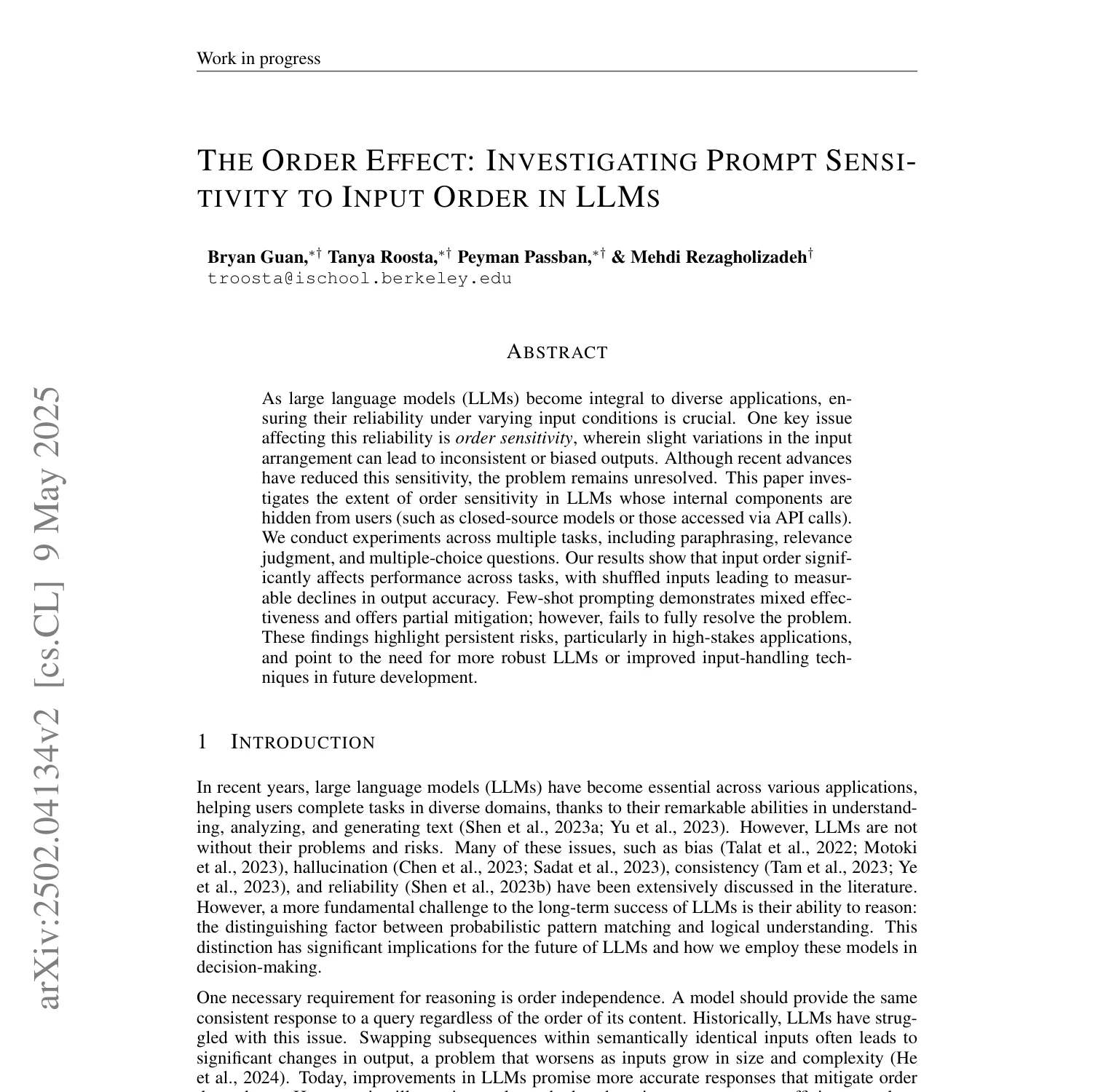
In five experiments, Bryan Guan, Tanya Roosta, Peyman Passban, and Mehdi Rezagholizadeh rearranged task inputs and measured whether GPT-4o, GPT-4o mini, and DeepSeek R1-Distill-Llama-70B changed their outputs. Their paper, The Order Effect: Investigating Prompt Sensitivity to Input Order in LLMs, covers sentence-pair classification, passage relevance, multiple-choice questions, medical multiple choice, and comparisons of answer pairs.
The overall pattern was a performance drop after shuffling, although its size varied by model and dataset. On the MS MARCO relevance task, GPT-4o mini’s zero-shot F1 went from 0.49 in the original order to 0.43 after the passages were shuffled. Few-shot examples sometimes narrowed the gap, but did not reliably remove it; on longer MS MARCO inputs they could lower performance further. The WebGPT pairwise-preference experiment ran against the broader trend: most model/settings combinations improved after answer order changed.
An exception is part of the result
The authors could not identify a consistent pattern explaining when shuffling helped or hurt. They tested three systems and a selected set of datasets, and described the paper as work in progress. These results do not show that every reorder degrades performance, or isolate a model-internal cause. In particular, the authors’ speculation about autoregressive training is not directly tested.
For an evaluator using an LLM to rank answers, both candidate orderings are worth checking: in this study, the same operation shifted benchmark scores in opposite directions across tasks.
Bibliography
- Bryan Guan, Tanya Roosta, Peyman Passban, and Mehdi Rezagholizadeh (2025). The Order Effect: Investigating Prompt Sensitivity to Input Order in LLMs. arXiv:2502.04134v2. Full paper (PDF).