A changed answer string is not always a changed answer
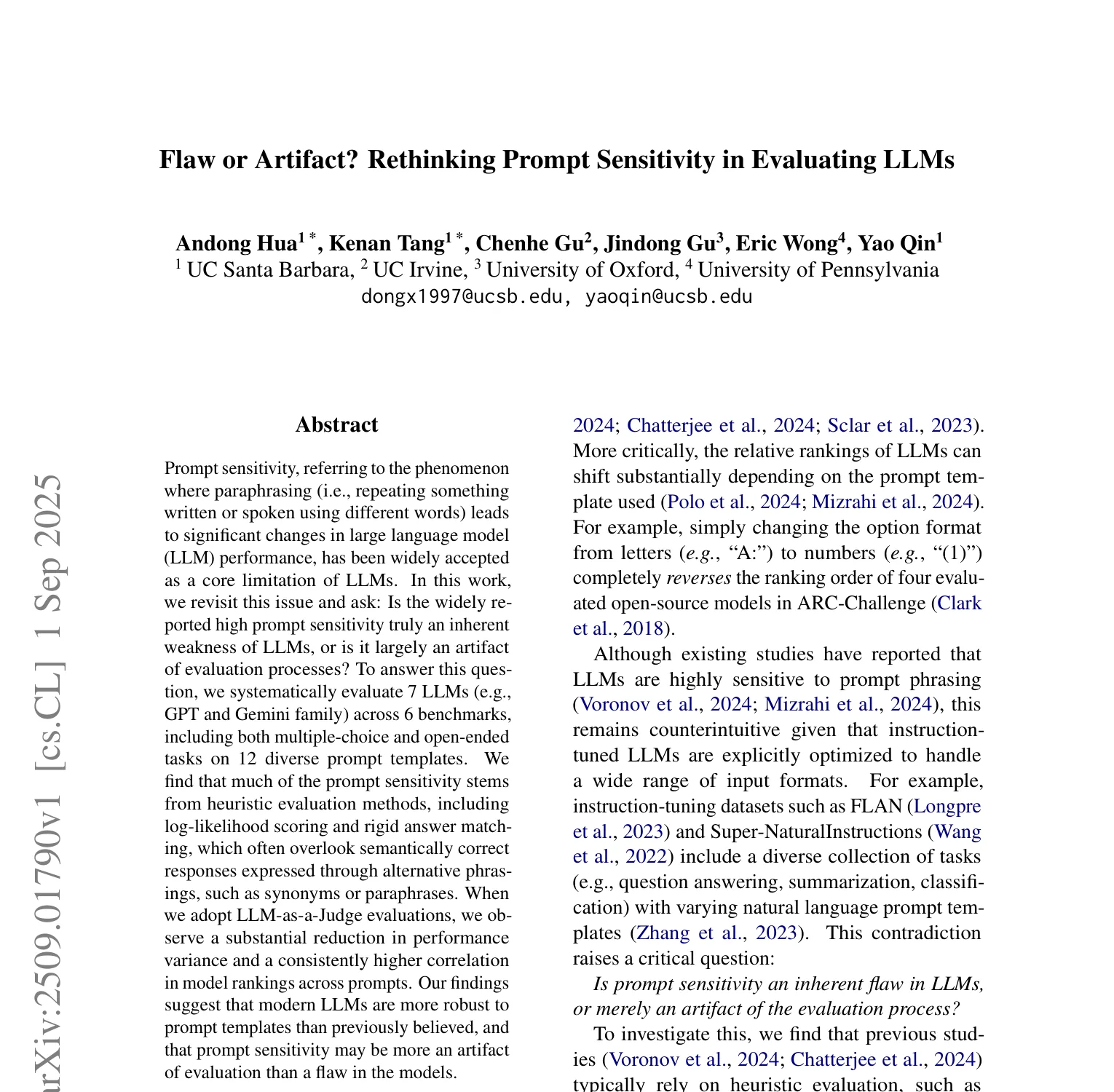
When two prompts elicit different wording, a benchmark’s scoring rule can turn a harmless paraphrase into a performance difference. Andong Hua, Kenan Tang, Chenhe Gu, Jindong Gu, Eric Wong, and Yao Qin examine that possibility in Flaw or Artifact? Rethinking Prompt Sensitivity in Evaluating LLMs.
They evaluated seven language models on six benchmarks, spanning multiple-choice and open-ended tasks, with twelve prompt templates. The comparison included conventional heuristics such as likelihood scoring and rigid answer matching, alongside GPT-4o as an LLM judge. The authors found that the heuristic measures often missed semantically correct responses expressed with synonyms or paraphrases. Using the judge reduced performance variance across templates and made model rankings more consistent.
The claim is about evaluation, not all user prompts
This does not show that models are insensitive to wording in ordinary use. It shows that some reported benchmark sensitivity can come from how an evaluator scores the output. That distinction is especially relevant when the answer is open-ended and exact string agreement is a poor proxy for correctness.
The study used twelve templates per benchmark because of computational limits. The authors report that, for ARC-Challenge, the ranking and variance estimates from twelve templates closely matched estimates from more than one hundred; that check does not establish the same result for every task. Judge-based scoring also substitutes one evaluation procedure for another, so its decisions remain part of the measurement.
Bibliography
- Andong Hua, Kenan Tang, Chenhe Gu, Jindong Gu, Eric Wong, and Yao Qin (2025). Flaw or Artifact? Rethinking Prompt Sensitivity in Evaluating LLMs. arXiv:2509.01790v1. Full paper (PDF).