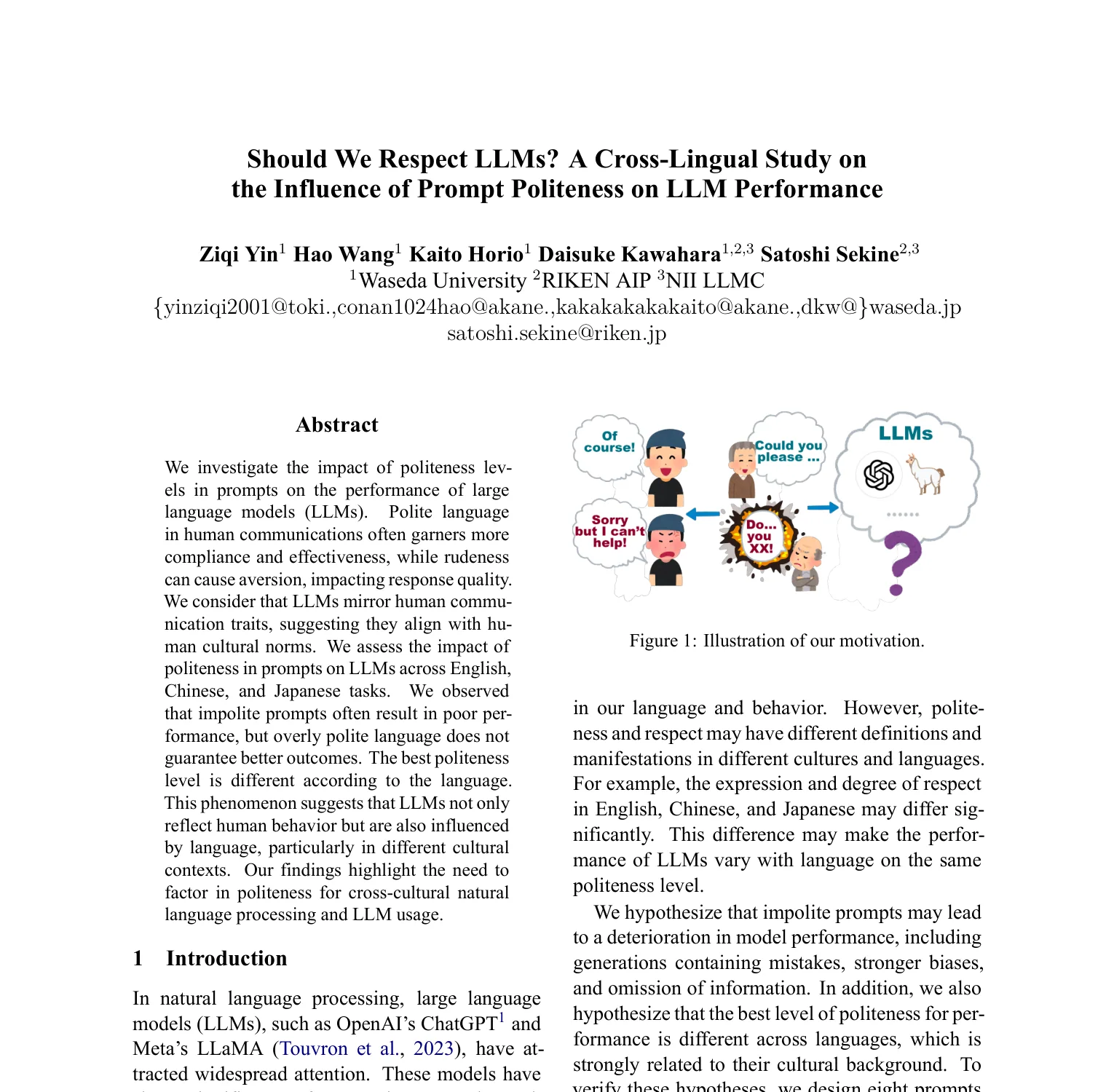
The same request can sound respectful in different ways
Ziqi Yin, Hao Wang, Kaito Horio, Daisuke Kawahara, and Satoshi Sekine varied prompt politeness in English, Chinese, and Japanese in Should We Respect LLMs? A Cross-Lingual Study on the Influence of Prompt Politeness on LLM Performance. They evaluated language-understanding questions using MMLU, C-Eval, and JMMLU, and compared GPT models with open models.
Their results were not a simple rule that more politeness produces better answers. The paper reports that impolite wording often lowered performance, but highly respectful wording did not consistently help; the best-performing level differed by language and model. This matters to interpretation because a tone effect in one language is not evidence of an identical effect in another. The authors also report that models trained primarily for a particular language were sensitive to that language’s politeness forms.
A cross-language result with a narrow base
The experiments depended on three benchmark collections and their available language coverage. The authors cite the cost of translation and proofreading, as well as dataset availability, as constraints on a broader evaluation. The study therefore does not map every cultural style or conversational setting, and the observed variation should not be read as a human-like response to courtesy.
For multilingual testing, the measured variable is not just whether a request is clear: its politeness conventions can also differ. This paper leaves open how those effects transfer to real interactions beyond its selected datasets and model set.
Bibliography
- Ziqi Yin, Hao Wang, Kaito Horio, Daisuke Kawahara, and Satoshi Sekine (2024). Should We Respect LLMs? A Cross-Lingual Study on the Influence of Prompt Politeness on LLM Performance. arXiv:2402.14531v2. Full paper (PDF).