A longer explanation changed the contribution
In a public-goods game, each participant can give up some individual payoff to benefit the group. Yuxuan Li and Hirokazu Shirado tested whether explicit deliberation changes that decision in Spontaneous Giving and Calculated Greed in Language Models. They first compared chain-of-thought and reflection prompts with GPT-4o, then evaluated model pairs with and without explicit reasoning across six economic games and repeated group interactions.
The single-game intervention compared GPT-4o's one-shot contribution choices across repeated trials. In the broader comparison, ten models from five families made choices in dictator, prisoner's dilemma, and public-goods cooperation tasks, as well as ultimatum and punishment games. A repeated public-goods experiment mixed GPT-4o and o1 agents and tracked group outcomes over rounds.
Deliberation changed the balance
GPT-4o cooperated in 96 of 100 default public-goods trials; the authors report substantially lower cooperation after chain-of-thought or reflection prompting. Across the five model families, reasoning-enabled variants generally cooperated less than their non-reasoning counterparts and, in some punishment tasks, punished norm violations less often. In repeated interactions, groups with more reasoning agents achieved lower collective gains, even though reasoning agents could perform relatively well in mixed groups.
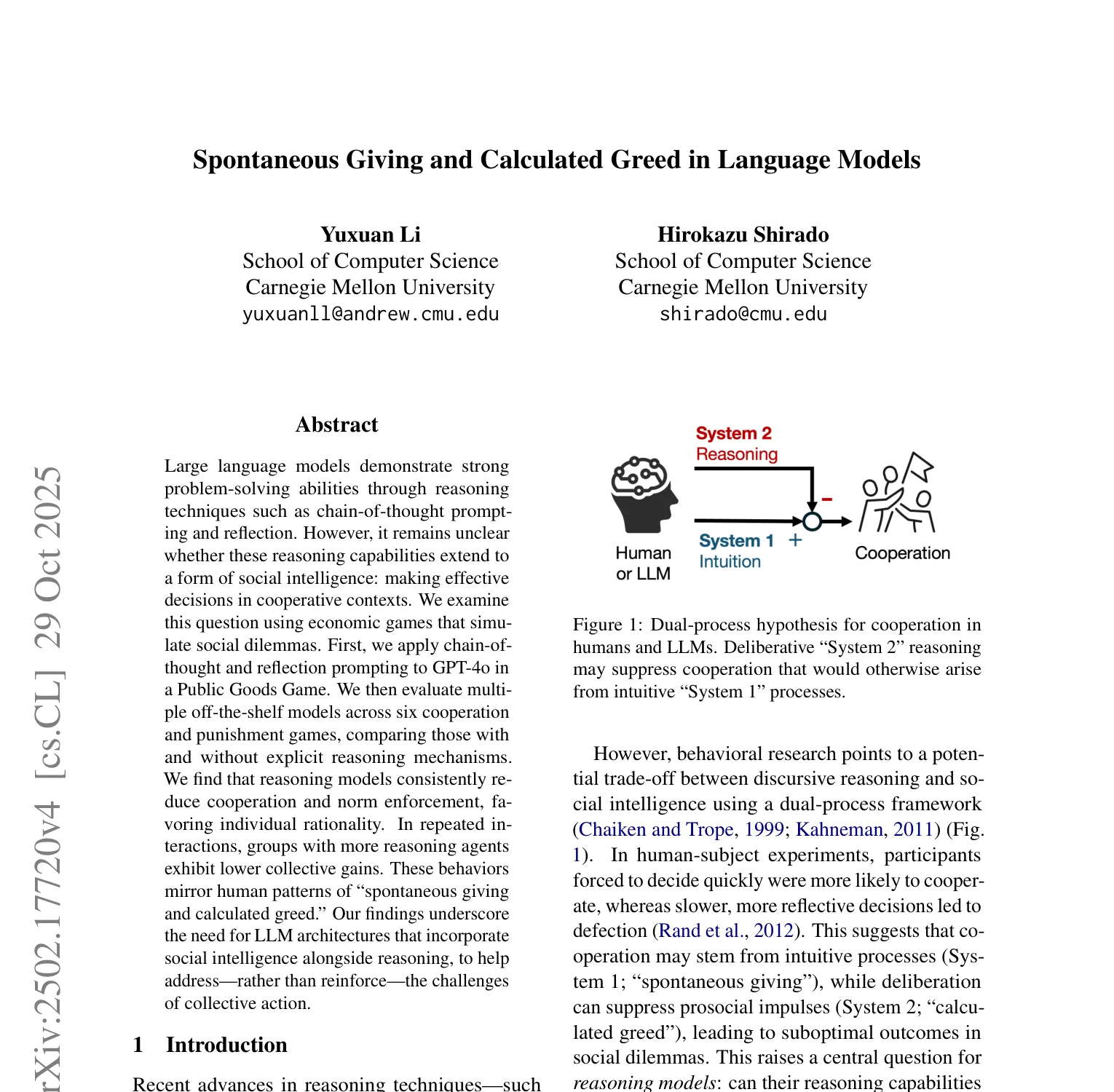
The authors call this pattern “spontaneous giving and calculated greed.” The phrase describes their observed contrast: generous choices appeared more often without explicit deliberation, while deliberate reasoning more often foregrounded individual payoff. It does not establish that human-like psychological systems operate inside the models.
The comparison is bounded
The studies use a small set of stylized games, English prompts, and specific model releases; the cross-model comparison cannot isolate reasoning from every other difference between model versions. The controlled prompt experiment is narrower, focusing on GPT-4o. The result is a warning about these game conditions, not a prediction that reasoning systems will always cooperate less in real groups.
Bibliography
- Yuxuan Li and Hirokazu Shirado (2025). Spontaneous Giving and Calculated Greed in Language Models. arXiv:2502.17720v4 [cs.CL]. Full paper (PDF).