The bird expert and the car expert
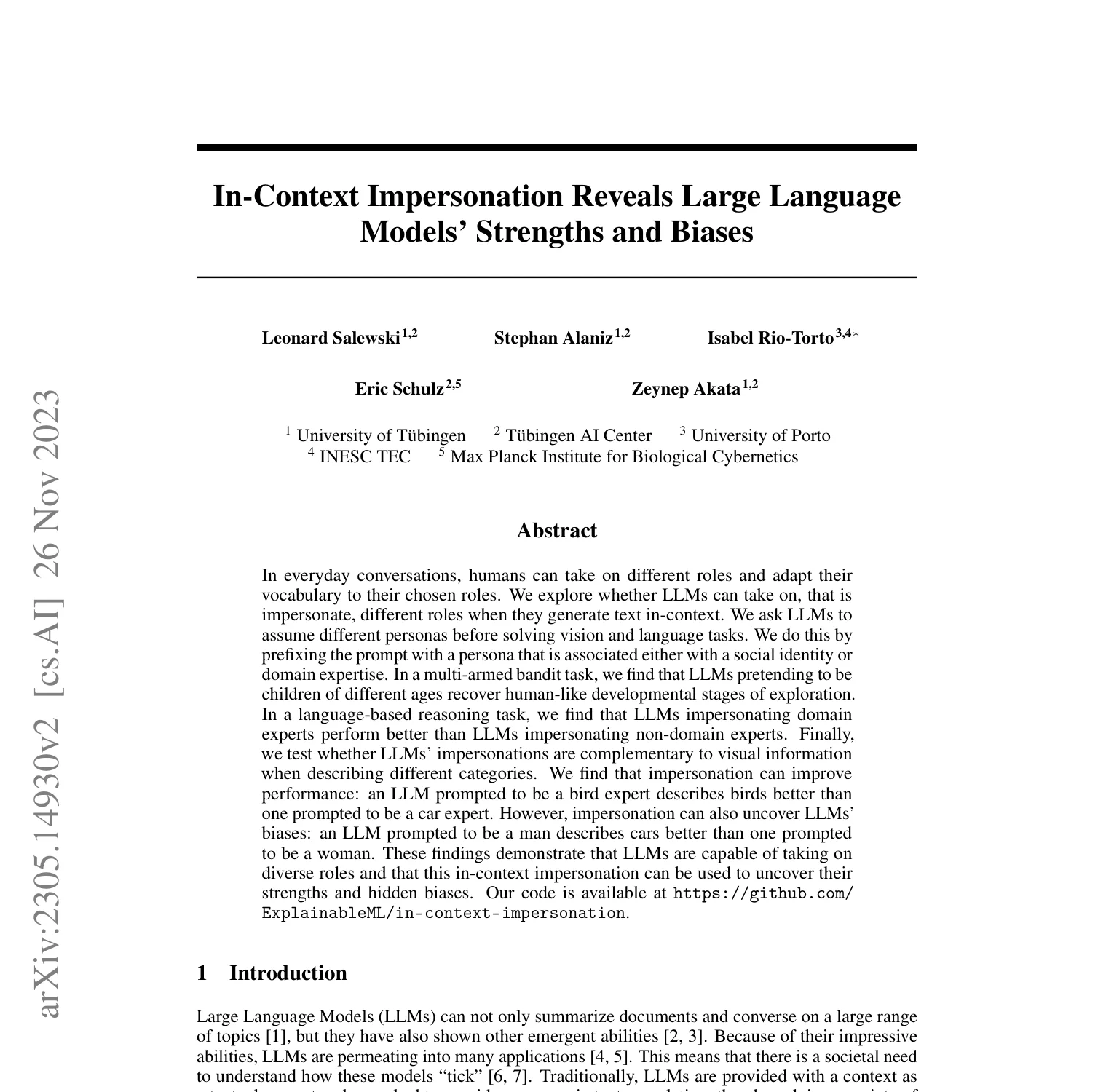
When a model is asked to describe birds for image classification, a bird-expert prompt can produce more useful descriptions than a car-expert prompt. Salewski and colleagues report that comparison in In-Context Impersonation Reveals Large Language Models’ Strengths and Biases. The prompt supplies a role; the downstream task supplies a way to measure its effect.
The researchers test Vicuna-13B and ChatGPT (GPT-3.5-turbo) across three settings. In a multi-armed bandit game, developmental-age personas change exploration over repeated choices. In a language-based knowledge task, domain-expert prompts outperform non-expert prompts. For vision-language classification, the models describe categories in datasets including CUB birds and Stanford Cars; those descriptions are then paired with images in a CLIP-style zero-shot pipeline. Expertise and social-identity roles are both tested.
Performance shifts and asymmetric descriptions
In the bandit experiment, the prompted age is associated with different exploration patterns resembling human developmental stages; the reported increase in reward with age levels off within the tested range. Expert roles help on the knowledge questions. In the image task, the bird-expert comparison shows a task-specific benefit from a relevant role.
A car-description comparison raises a different issue: the model prompted as a man describes cars better than the one prompted as a woman. The paper's gender and race patterns vary with the model and task. They describe behavior elicited by prompts, not the abilities of people who share those identities. Nor does a role prompt establish that a model has taken on a human identity.
These experiments use two models, selected prompts, a simplified decision game, knowledge questions and particular image datasets and classification steps. The findings could change with wording, models or evaluation choices. Researchers using roles as interventions can measure a benefit and check for uneven effects under the same task conditions; neither a universal performance boost nor a ranking of social groups follows from these results.
Bibliography
- Salewski, L., Alaniz, S., Rio-Torto, I., Schulz, E., & Akata, Z. (2023). In-Context Impersonation Reveals Large Language Models’ Strengths and Biases. In Advances in Neural Information Processing Systems 36 (NeurIPS 2023), pp. 72044–72057. https://doi.org/10.52202/075280-3152. arXiv:2305.14930 [cs.AI]. Full paper (PDF).