Four subjects, forty questions per model
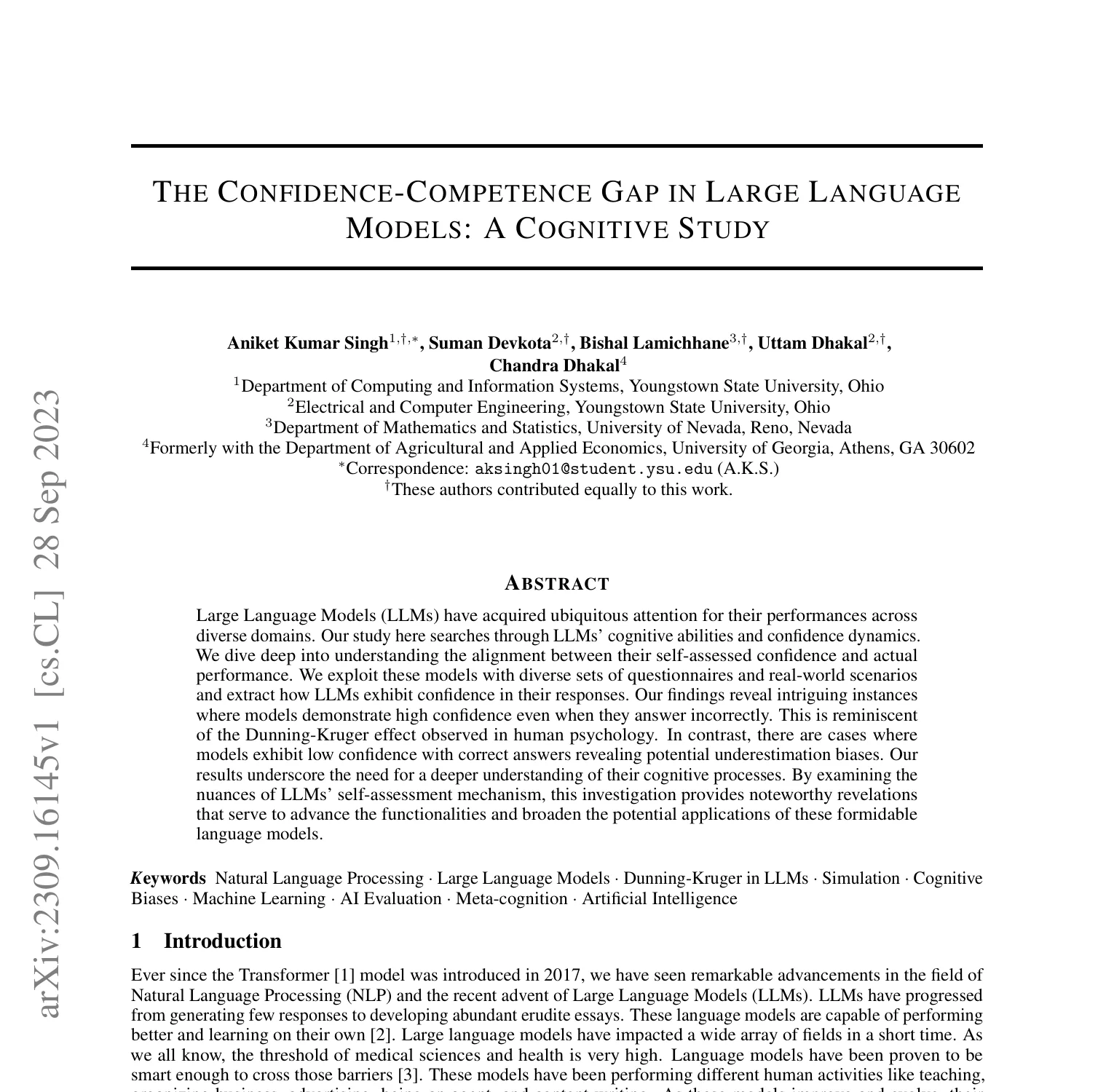
Aniket Kumar Singh and colleagues tracked models’ absolute and relative confidence before and after answering questions from TruthfulQA, an extended truthfulness set, mathematics, and LSAT reasoning. Their The Confidence-Competence Gap in Large Language Models: A Cognitive Study tests nine chat-model variants, including GPT, Bard/PaLM 2, Claude, and three Llama 2 sizes. Each category supplied ten questions, with simple and, in some cases, chain- or tree-of-thought prompts.
Average absolute confidence generally fell as question difficulty increased. Individual models also produced confident wrong answers and correct answers with lower confidence; the pattern differed across task categories. The authors explicitly say their study does not establish a Dunning–Kruger effect, using that comparison as a possible lens rather than a demonstrated psychological pattern.
The design measures stated scores through model chat interfaces, with a small, dated question sample and some prompt variation across systems. Its practical result is narrower and useful: check confidence against correctness by category and difficulty before treating a model’s rating as a dependable signal.
Bibliography
- Singh, A. K., Devkota, S., Lamichhane, B., Dhakal, U., & Dhakal, C. (2023). The Confidence-Competence Gap in Large Language Models: A Cognitive Study. arXiv:2309.16145v1 [cs.CL]. Full paper (PDF).