Forty personas, three model families
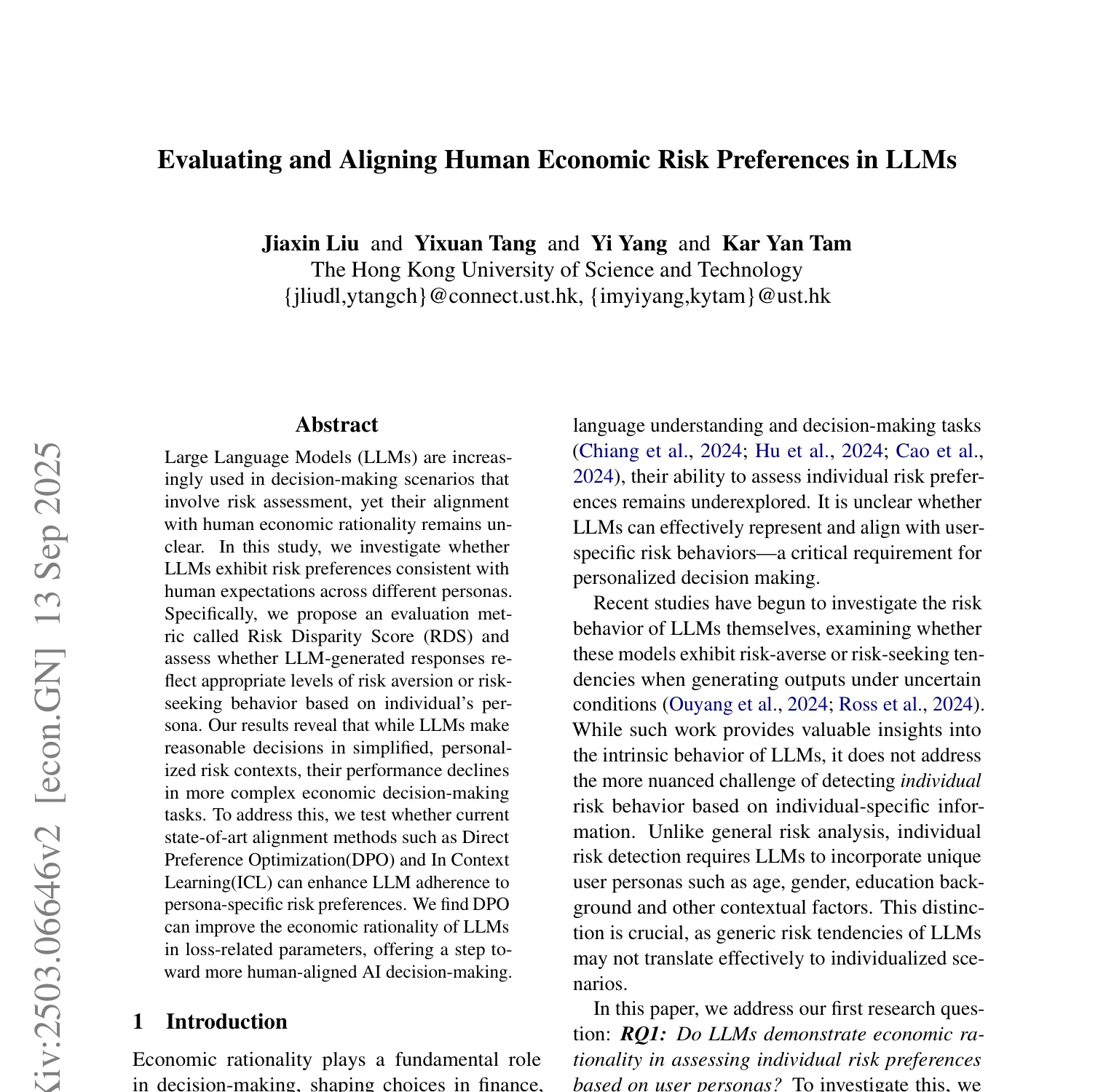
A person may accept a gamble when facing a possible gain and reject one when facing a possible loss. Jiaxin Liu, Yixuan Tang, Yi Yang, and Kar Yan Tam examine whether models can infer such distinctions from a described persona in Evaluating and Aligning Human Economic Risk Preferences in LLMs. They create 40 personas across four prospect-theory profiles and evaluate three instruction-tuned models on simpler and more complex economic tasks. Their Risk Disparity Score (RDS) measures whether choices separate those assigned profiles.
DPO changed the loss-related score most
Models performed better on simplified risk scenarios; performance fell on more complex decisions. Direct Preference Optimization improved loss-related preference recognition. On Llama 3 8B Instruct, the reported loss-parameter RDS rose from 0.58% to 97.02%, while the gain-related score did not improve in the same way.
RDS describes benchmark separation among assigned profiles, not a frequency estimate of real people’s choices. The authors evaluate models under 10B parameters, omit preferences such as time discounting and inequity aversion, and note that a demographic label cannot express variation within a group. A follow-up can test whether the inferred profile predicts choices when the task becomes less schematic.
Bibliography
- Liu, J., Tang, Y., Yang, Y., & Tam, K. Y. (2025). Evaluating and Aligning Human Economic Risk Preferences in LLMs. arXiv:2503.06646v2 [econ.GN]. Full paper (PDF).