A reversal in 66 of 80 comparisons
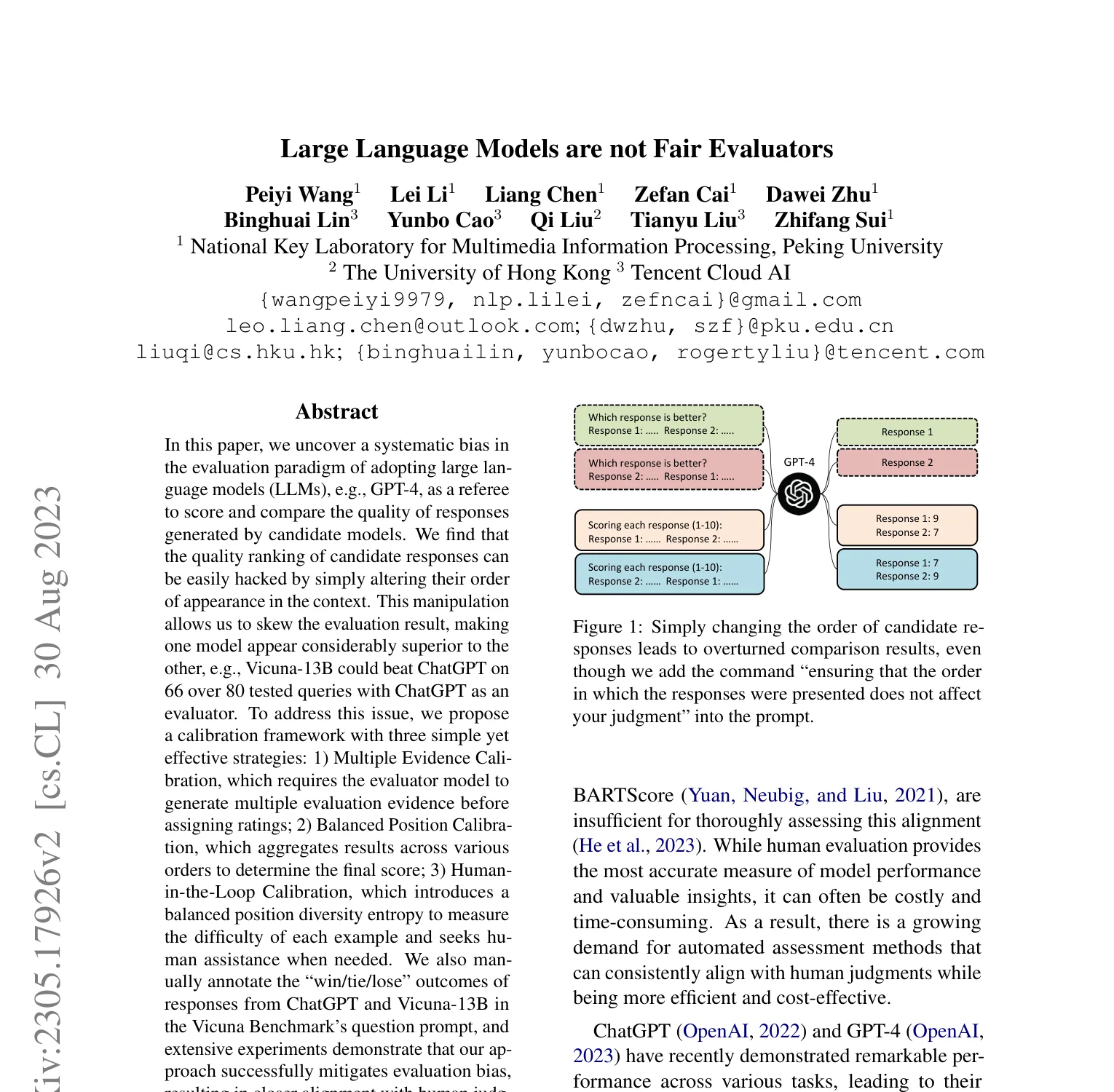
Wang and colleagues report that changing the order of two candidate responses could make Vicuna-13B beat ChatGPT on 66 of 80 tested queries when GPT-4 judged the answers. The paper, Large Language Models are not Fair Evaluators, demonstrates that a simple ordering change can move the verdict even when the prompt tells the evaluator to disregard position.
The authors compare ChatGPT and GPT-4 judgments with human annotations of Vicuna-13B and ChatGPT responses, scored for helpfulness, relevance, accuracy, and detail. Their FairEval framework combines multiple evaluation evidence, balanced candidate positions, and human review for cases estimated to be difficult for the evaluator.
Calibrating the decision
The paper reports that these strategies reduce positional bias and move ratings closer to human judgments. The human-in-the-loop component is meant to direct review toward uncertain examples. The experiments use particular prompts, answer pairs, judge versions, and annotators; the 66-of-80 result is a targeted demonstration, not an estimate of how often order flips decisions across deployed evaluations. In the tested setup, the next comparison to reproduce is the same response pair with its order reversed.
Bibliography
- Wang, P., Li, L., Chen, L., Cai, Z., Zhu, D., Lin, B., Cao, Y., Liu, Q., Liu, T., & Sui, Z. (2023). Large Language Models are not Fair Evaluators. arXiv:2305.17926v2 [cs.CL]. https://arxiv.org/pdf/2305.17926